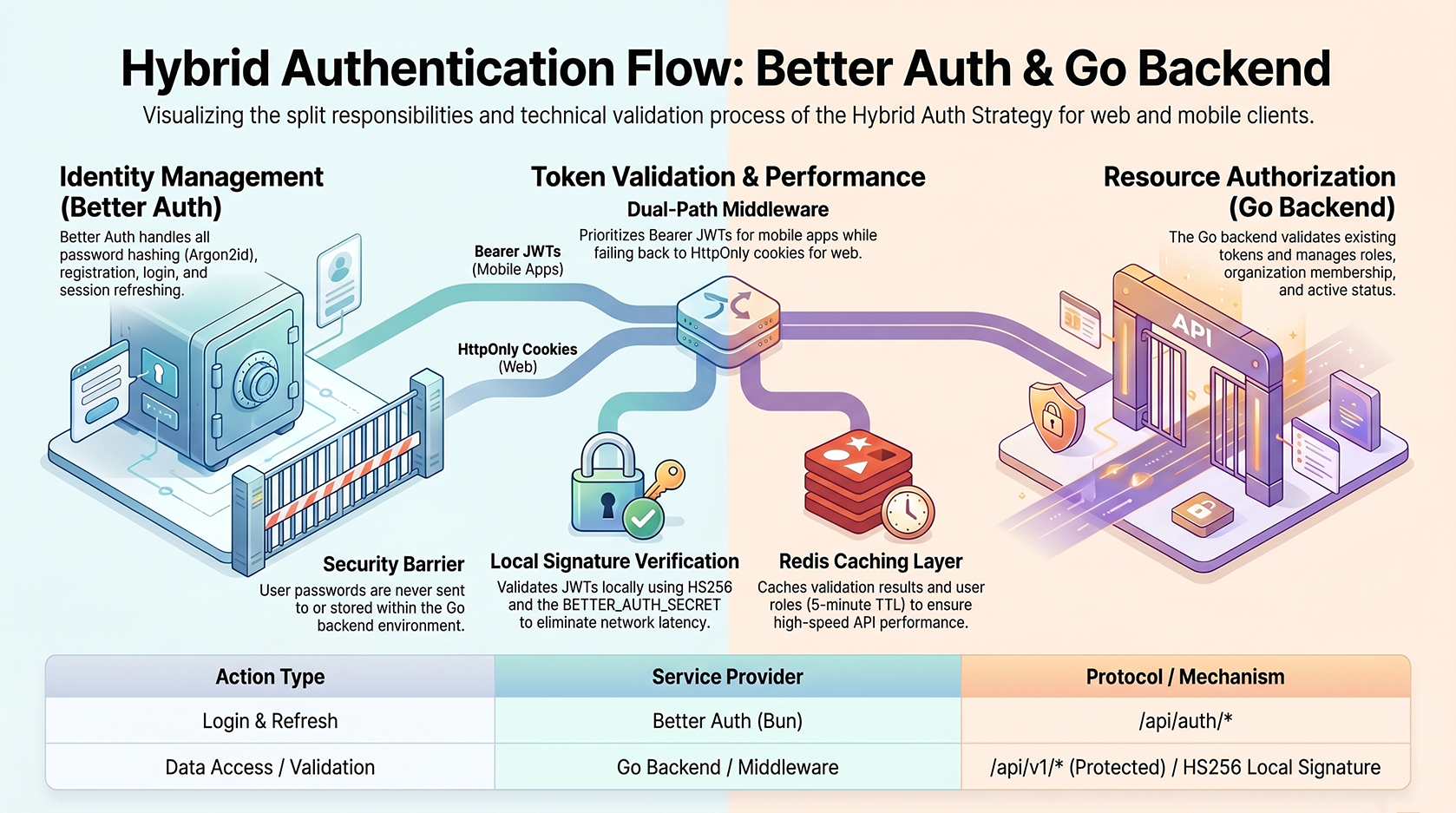
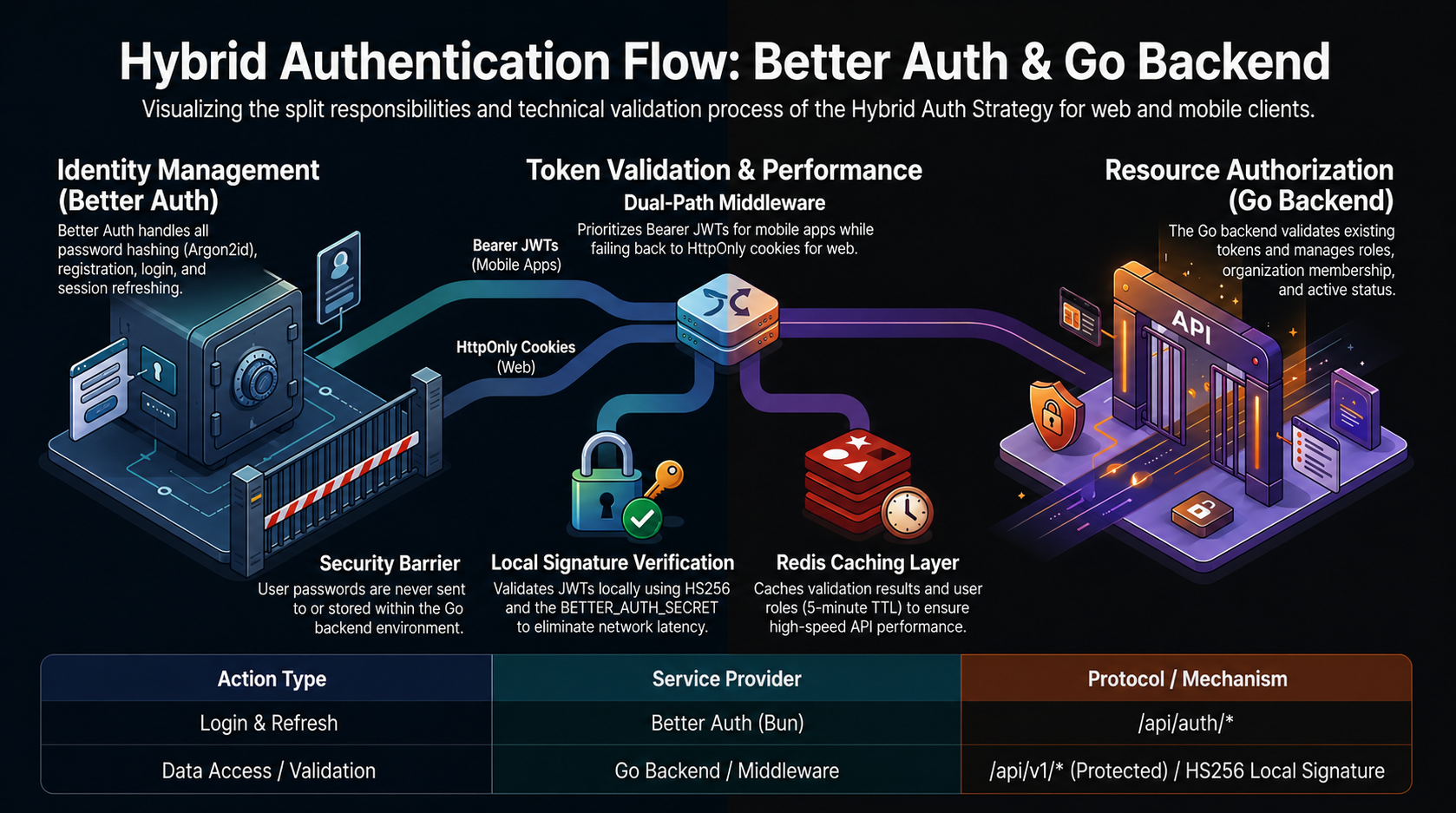
Overview
The Authentication module handles JWT validation and user session verification using tokens issued by Better Auth (Bun monolith). It supports a Hybrid Auth Strategy to accommodate both web browsers and mobile applications:- Web Clients: Use secure HttpOnly cookies (
better-auth.session_token), validated via HTTP fallback to Better Auth. - Mobile Clients: Use JWT Bearer tokens in the
Authorizationheader, validated locally with signature verification.
Functional Requirements
1. Login (Handled by Better Auth in Bun)
- Input: Email, Password (sent to Better Auth).
- Business Rules:
- Better Auth verifies email exists.
- Better Auth verifies password matches stored hash (
scrypt). - If valid, Better Auth generates session tokens and JWTs.
- Output: JWT token, session cookie, user profile.
2. JWT Token Validation (Handled by Go Middleware)
- JWT Token:
- Issued by Better Auth (Bun).
- Contains AuthID, Email, OrganizationId, ExpirationTime.
- Signed with BETTER_AUTH_SECRET (HS256).
- Validated locally by Go middleware without network calls (cached).
- Session Cookie (for web clients):
better-auth.session_tokenissued by Better Auth.- Validated via HTTP fallback to Better Auth if JWT validation fails.
- Automatically refreshed by Better Auth.
3. Protected Routes (Middleware)
- Input:
- Path A (Web):
better-auth.session_tokencookie. - Path B (Mobile/Apps):
Authorization: Bearer <token>header.
- Path A (Web):
- Business Rules:
- Prioritize Authorization header if present.
- Fallback to cookie validation.
- Validate JWT signature and expiration locally (HS256 with BETTER_AUTH_SECRET).
- Query Better Auth service if local JWT validation fails (for session tokens).
- Query local
userstable to fetch user roles, organization, and active status. - Extract AuthID, Email, Roles, OrganizationId, and IsActive into request context.
- Return 401 Unauthorized if token invalid or expired.
- Return 403 Forbidden if user is inactive.
- Caching:
- Cache JWT validation result in Redis (keyed by token hash, expires at JWT expiration time).
- Cache user status (roles, active status) in Redis with 5-minute TTL.
- Invalidate user status cache on NATS user sync events (TODO).
Security Measures
- Passwords: Handled exclusively by Better Auth (Bun), never sent to or stored in Go backend.
- BETTER_AUTH_SECRET: Must be loaded from environment variables, never hardcoded. Used for JWT signature validation.
- JWT Signature Algorithm: HS256 (HMAC SHA-256).
- Password Hashing: Bun consolidation will use
scrypt(Better Auth default). - Token Expiration: JWT tokens are short-lived; session tokens are automatically refreshed by Better Auth.
- Cache Invalidation: User status cache should be invalidated immediately on NATS sync events to avoid serving stale role/status data.
API Endpoints
Note: Login, registration, and token refresh are handled by Better Auth (Bun). These endpoints are NOT in the Go backend. Better Auth (Bun) Endpoints:POST /api/auth/sign-up/email- User registrationPOST /api/auth/sign-in/email- User loginPOST /api/auth/sign-out- User logoutPOST /api/auth/refresh- Refresh session token
- All endpoints in
/api/v1/*require valid JWT or session token - Middleware automatically validates token and populates request context with user info